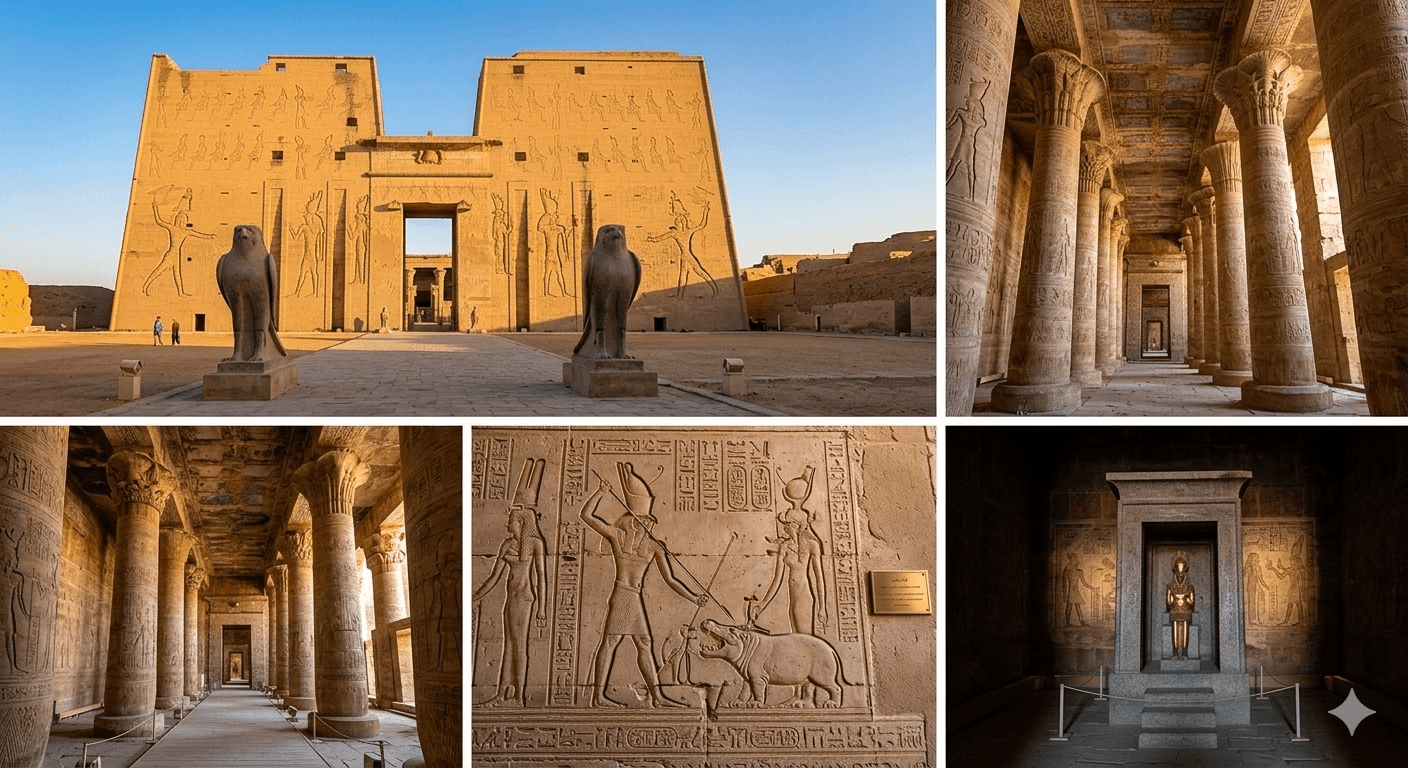
While Giza offers scale and Luxor offers grandeur, the Temple of Horus at Edfu offers something truly unique in Egypt: perfection.
Located on the west bank of the Nile between Luxor and Aswan, Edfu is one of the most remarkably preserved shrines from the ancient world. It is not just a building; it is a time capsule, offering an untarnished look at the architecture, rituals, and myths of Ptolemaic Egypt.
If you want to step into the past and feel how a temple operated 2,000 years ago, Edfu must be on your itinerary.
1. The Power of Preservation: Why Edfu is Unique
Built between 237 BCE and 57 BCE during the Ptolemaic Kingdom, Edfu Temple is much "younger" than the monuments of Giza or the Valley of the Kings. However, its youth isn't the reason for its flawless condition.
For centuries, the entire temple was swallowed by the desert sands, buried right up to the top of its massive pylon towers. Only when the French archaeologist Auguste Mariette excavated it in the 1860s was it revealed to the world, protected from the elements and the vandalism that defaced other sites.
Today, you can walk through its halls and see original ceilings intact and reliefs that are almost perfectly sharp, offering a window into antiquity that other sites only hint at.
2. A Journey Through the Monumental Gate
Your arrival at Edfu is defined by scale. The Pylon (the entrance gate) is an absolute masterpiece of ancient design.
Standing 36 meters (118 feet) high, it is adorned with towering reliefs of Ptolemy XII slaying his enemies before the gods Horus and Hathor. These reliefs are raw political propaganda, carved with stunning detail.
As you pass through this gateway, look to your left and right: two massive, impeccably carved granite statues of Horus as a Falcon greet you. They stand guard, reminding visitors that they are entering the sacred precinct of the sky god.
3. Divine Mythology: The Triumph of Horus
Edfu is fundamentally a story told in stone. Its walls depict the "Triumph of Horus," the central myth of Egyptian theology.
Horus (the Falcon God, representing order and kingship) is destined to battle his uncle Seth (the Chaos God, depicted often as a hippo) to avenge the murder of his father, Osiris. The temple is built on the precise location where this cosmic battle supposedly took place.
The dramatic scenes lining the walls of the temple’s corridors show Horus spearing Seth (the hippo) in a series of dynamic, action-oriented reliefs that are unmatched in Egyptian art. As you walk the temple, you are literally witnessing the victory of good over evil.
4. Architectural Marvels Inside the Pylon
Beyond the main gate lies a world of Ptolemaic splendor:
The Court of Offerings: This vast, open-air plaza is surrounded by columns, designed to accommodate large public crowds during grand festivals. Here, you can truly appreciate the temple's sheer scale against the desert sky.
The Hypostyle Halls: Moving deeper, the sunlight is restricted, creating a mysterious, sacred atmosphere. The Great Hypostyle Hall features soaring columns with botanical capitals, and the intact ceiling displays cosmic imagery and the zodiac.
The Sanctuary: The most sacred and dark chamber, located at the heart of the complex, still contains a granite shrine (naos) that once housed the golden cult statue of Horus. You are standing where only high priests and the King were permitted to enter.
Pro-Tips for Your Visit to Edfu
Beating the Heat: Edfu is a natural heat trap. Arrive as early as possible (opening is generally 6:00 AM) to enjoy the site comfortably before the midday sun.
Combos are Best: Edfu is often visited as a multi-stop day trip along with the Temple of Kom Ombo.
Don't Forget Deir el-Medina: To truly understand the story of the artisans who built temples, visit the Nearby Workers’ Village for context.