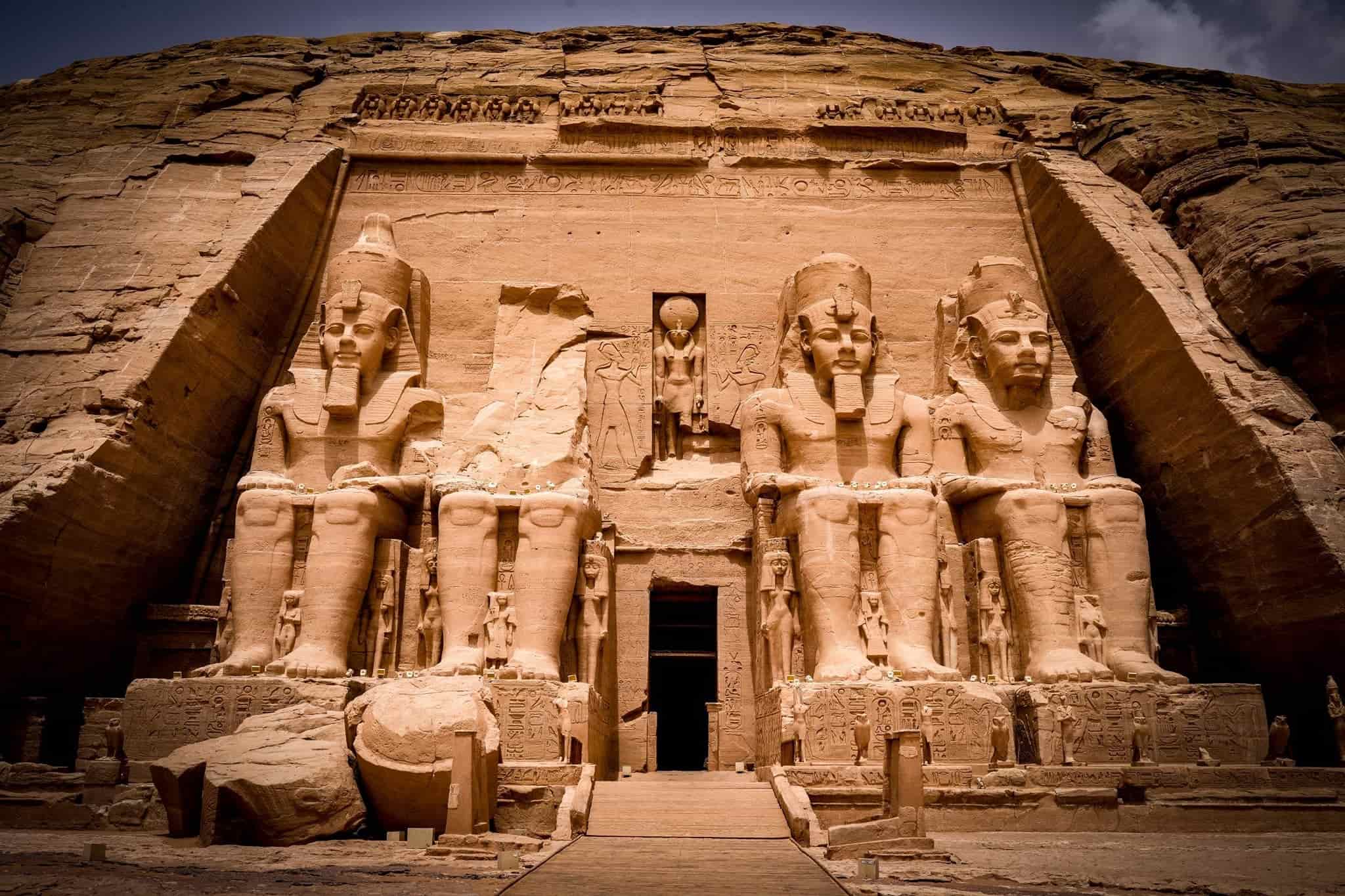
The Eternal Majesty of Abu Simbel: A Journey to Egypt’s Southern Frontier
Deep in the heart of the Nubian desert, where the golden sands meet the sapphire waters of Lake Nasser, stands one of humanity’s most breathtaking achievements: The Abu Simbel Temples.
Commissioned by the legendary Pharaoh Ramesses II (Ramesses the Great) in the 13th century BCE, these two rock-cut masterpieces were designed not just as places of worship, but as eternal symbols of power, love, and divine right.
1. The Great Temple: A Monument to a Living God
The Great Temple is a marvel of ancient propaganda and architectural genius. Dedicated to the gods Amun, Ra-Horakhty, and Ptah, it serves primarily to deify Ramesses II himself.
The Facade: Four colossal seated statues of Ramesses II dominate the entrance, each standing a staggering 20 meters (66 feet) tall. At his feet, smaller statues represent his favorite wife, Nefertari, his mother, Mut-Tuy, and his children.
The Hypostyle Hall: Inside, eight massive pillars carved into the shape of Osiris (the god of the underworld) bear the face of Ramesses, leading you deeper into the mountain.
The Battle of Kadesh: The walls are alive with intricate reliefs depicting the Pharaoh’s military triumphs, most notably the famous Battle of Kadesh, featuring over 1,100 finely carved figures.
2. The Small Temple: A Legacy of Love
Just 100 meters away lies the Temple of Hathor and Nefertari. What makes this temple truly unique is the rare honor Ramesses bestowed upon his "Great Royal Wife."
Equal Stature: On the facade, the statues of Queen Nefertari are carved at the same height as the Pharaoh—a radical departure from traditional Egyptian art where queens were typically depicted reaching only to the King’s knees.
Divine Beauty: Dedicated to Hathor, the goddess of love and music, the interior is adorned with delicate scenes of the Queen offering lotus flowers to the gods, radiating a grace that balances the raw power of the Great Temple.
3. The Sun Miracle: A Celestial Alignment
The ancient Egyptian architects were also master astronomers. They oriented the Great Temple with such precision that twice a year, a "Sun Miracle" occurs:
The Dates: On February 22 (marking his ascension to the throne) and October 22 (his birthday), the first rays of the rising sun pierce the darkness of the temple.
The Phenomenon: The light travels 60 meters through the halls to illuminate three statues in the sanctuary: Amun, Ra-Horakhty, and Ramesses II.
The God of Darkness: Interestingly, the statue of Ptah remains in shadow, as he was associated with the underworld and never intended to touch the light.
4. The Great Rescue: A Modern Wonder
In the 1960s, Abu Simbel faced a modern threat: the rising waters of the Nile due to the construction of the Aswan High Dam. In a feat of engineering that rivaled the original construction, UNESCO led a global effort to save the temples.
Engineers meticulously cut the entire complex into over 1,000 massive blocks (some weighing up to 30 tons) and moved them 65 meters higher and 200 meters inland. Today, they sit against an artificial mountain, preserved exactly as they were over 3,000 years ago.
Plan Your Visit
How to Get There: Most travelers take a short flight or a 3-hour desert drive from Aswan.
Best Time to Visit: Arrive at dawn to witness the sunrise over Lake Nasser. If you can, plan your trip for the Sun Festival in February or October for a once-in-a-lifetime experience.
Don't Miss: The Sound and Light Show at night, which uses projections to tell the story of the Pharaoh and the temple’s relocation.
Travel Tip: Carry plenty of water and wear a hat! The Nubian sun is as powerful today as it was in the time of the Pharaohs.