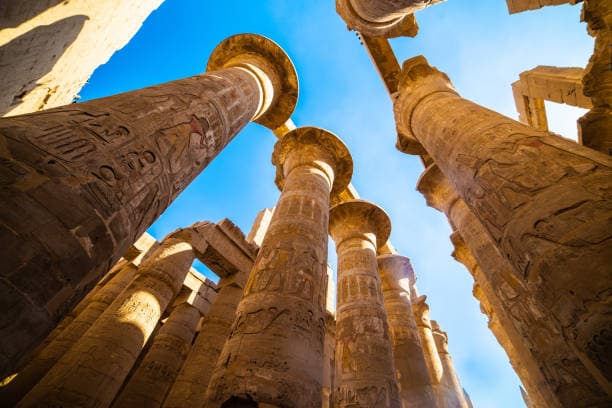
The Karnak Temple Complex : is one of the most significant and largest temple complexes in ancient Egypt. Located on the east bank of the Nile River near Luxor (ancient Thebes), it served as a religious center for nearly 2,000 years, spanning multiple dynasties and pharaohs. The construction of Karnak began in the Middle Kingdom (around 2000 BCE) and continued through the New Kingdom (1550–1070 BCE) and beyond.
Here's an overview of the key features and aspects of the Karnak Temple Complex:
Layout and Structure: Karnak is not a single temple but a vast complex of temples, chapels, pylons, and other structures covering over 200 acres. Its main axis runs from north to south. The complex is divided into several precincts, each dedicated to different deities and containing numerous temples and shrines.
Great Hypostyle Hall: One of the most impressive features of Karnak is the Great Hypostyle Hall, located within the precinct of Amun-Ra. This hall, built by Seti I and completed by his son Ramesses II, consists of 134 massive columns arranged in 16 rows. The columns reach heights of up to 23 meters and are decorated with intricate hieroglyphic inscriptions and reliefs.
Temple of Amun: The central focus of Karnak is the Temple of Amun, dedicated to the god Amun-Ra, the chief deity of the Egyptian pantheon during the New Kingdom. The temple was continuously expanded and embellished by successive pharaohs, including Hatshepsut, Thutmose III, Amenhotep III, and Ramesses II. It consists of a series of courtyards, halls, and sanctuaries, adorned with colossal statues, obelisks, and other religious iconography.
Sacred Lake: Adjacent to the Temple of Amun is the Sacred Lake, an artificial body of water used for ritual purification and ceremonial purposes. It is one of several such lakes found within the Karnak complex.
Precincts and Chapels: In addition to the main Temple of Amun, Karnak contains several other precincts and chapels dedicated to various deities, including Mut, Khonsu, and Montu. These smaller temples feature their own distinctive architectural styles and religious symbolism.
Avenue of Sphinxes: Connecting the Karnak Temple Complex to the Luxor Temple is the Avenue of Sphinxes, a long processional pathway lined with sphinx statues. This avenue was used for religious processions and ceremonies during ancient times.
Religious Significance: Karnak served as the primary religious center of ancient Egypt and played a crucial role in the worship of Amun-Ra and other gods. It was the site of elaborate festivals, rituals, and ceremonies conducted by the pharaohs and priesthood to honor the gods, seek divine guidance, and ensure the prosperity and stability of the kingdom.
Overall, the Karnak Temple Complex stands as a testament to the grandeur, power, and spiritual beliefs of ancient Egypt. Its monumental architecture, rich symbolism, and religious significance continue to fascinate visitors and scholars alike, offering insights into the civilization that created it.