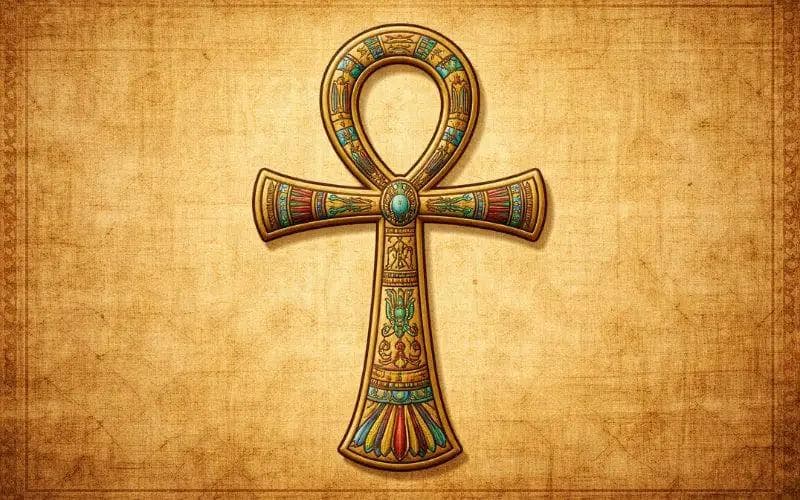
1. Ankh – The Symbol of Life
The Ankh (☥) is one of the most famous symbols of Ancient Egypt and is often called the "Key of Life" or the "Cross of Life." It symbolizes life, eternal existence, immortality, and divine power.
The Ankh frequently appears in the hands of Egyptian gods and goddesses, who are shown offering it to pharaohs as a gift of life and protection. It was also believed to represent the union of heaven and earth, as well as the balance between masculine and feminine energies.
Ancient Egyptians commonly wore Ankhs as amulets to attract health, prosperity, happiness, and protection. Today, it remains one of the most recognizable symbols of Ancient Egyptian civilization.
2. Eye of Horus (Wedjat Eye) – Protection and Healing
The Eye of Horus, also known as the Wedjat Eye, is one of Ancient Egypt's most powerful protective symbols. According to Egyptian mythology, the god Horus lost his left eye during a battle with Seth while avenging the death of his father, Osiris. The eye was later restored by the god Thoth, making it a symbol of healing, restoration, and wholeness.
The Eye of Horus was believed to protect people from evil spirits, disease, and misfortune. Sailors painted it on ships for safe voyages, while travelers and soldiers carried it as a protective amulet.
The symbol also represented wisdom, good health, and the watchful eye of the gods.
3. Scarab – Rebirth and Transformation
The Scarab Beetle was associated with Khepri, the god of the rising sun and creation. Egyptians observed scarab beetles rolling balls of dung across the ground and compared this movement to the sun crossing the sky each day.
Because of this connection, the scarab became a symbol of rebirth, transformation, renewal, and the continuous cycle of life.
Scarab amulets were among the most popular protective objects in Ancient Egypt. Heart scarabs were placed inside mummies to protect the deceased during the judgment in the afterlife and to ensure a successful journey into eternal life.
4. Djed Pillar – Stability and Endurance
The Djed Pillar is one of the oldest religious symbols in Ancient Egypt and represents stability, strength, endurance, and permanence. It is closely associated with Osiris, the god of the afterlife, resurrection, and fertility.
The Djed was believed to represent the backbone of Osiris, symbolizing his resurrection after death. During important religious festivals, priests performed the "Raising of the Djed" ceremony to celebrate renewal, stability, and the triumph of order over chaos.
The symbol reminded Egyptians that both society and the universe depended on balance and stability.
5. Was Scepter – Power and Dominion
The Was Scepter symbolized power, authority, dominion, and divine control. It was carried by gods, pharaohs, and high-ranking officials as a sign of leadership and strength.
The scepter features a long staff with the head of the mythical Set animal at the top and a forked base. It represented the ruler's ability to maintain order and defeat chaos.
The Was Scepter frequently appears in temple carvings, statues, and tomb paintings, emphasizing the divine authority granted to Egypt's rulers.
6. Winged Sun Disk – Divine Protection
The Winged Sun Disk combines the image of the sun with the outstretched wings of a falcon. It symbolizes royal authority, divine protection, victory, and the eternal power of the sun god, Ra.
According to Egyptian tradition, the Winged Sun Disk represented Horus in his victorious form, protecting Egypt from its enemies.
It was commonly carved above temple entrances, gateways, and sacred buildings to guard them against evil forces and to show that the gods watched over these holy places.
7. Feather of Ma'at – Truth, Justice, and Balance
The Feather of Ma'at belonged to Ma'at, the goddess of truth, justice, harmony, and cosmic order. It represented honesty, fairness, morality, and balance in both society and the universe.
In the famous Judgment of the Dead, the heart of the deceased was weighed against the Feather of Ma'at. If the heart was lighter than or equal to the feather, the person had lived a righteous life and was allowed to enter the eternal paradise known as the Field of Reeds.
This ceremony emphasized that moral behavior and truthfulness were essential values in Ancient Egyptian society.
8. Shen Ring – Eternity and Infinite Protection
The Shen Ring is a simple circular symbol with no beginning and no end, representing eternity, infinity, completeness, and everlasting protection.
The word Shen means "to encircle," symbolizing the eternal cycle of life and the universe. Gods and pharaohs were often depicted holding the Shen Ring as a sign of their responsibility to protect Egypt forever.
The symbol also represented the sun's endless daily journey and the belief that life continues beyond death. It was frequently incorporated into jewelry and royal decorations as a protective emblem.