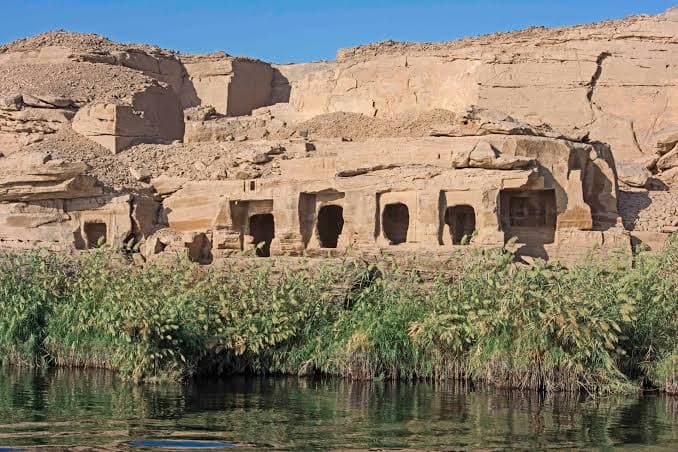
The name "El-Silsila," meaning "the chain," refers to the narrowest stretch of the Nile, where the river passes dramatically between towering sandstone cliffs. In ancient times, the site was known as Kheny, meaning "The Place of Rowing," reflecting its importance as both a transportation hub and a strategic point along the Nile.
The Quarry That Built an Empire
Beginning in the Middle Kingdom and reaching its peak during the New Kingdom, Gebel El-Silsila became Egypt's primary source of high-quality Nubian sandstone. Thousands of workers extracted massive stone blocks that were transported by boat to construction sites across the country.
The sandstone from Gebel El-Silsila was used to build and expand some of Egypt's most famous temples, including Karnak, Luxor, Edfu, Esna, Dendera, and Kom Ombo. The durability of sandstone allowed ancient architects to create larger columns, gateways, and monumental structures than had been possible with limestone alone.
More Than Just a Quarry
Although famous for its quarries, Gebel El-Silsila was also a thriving settlement and sacred landscape. Archaeologists have uncovered workers' villages, tombs, shrines, temples, rock-cut chapels, and thousands of inscriptions left by quarrymen, officials, priests, and travelers over thousands of years.
Among the site's highlights is the magnificent Speos of Horemheb, a rock-cut temple dedicated to several deities, including Amun, Sobek, Mut, Khonsu, and Khnum. The cliffs are also lined with beautifully carved shrines belonging to high-ranking officials from the reigns of Hatshepsut and Thutmose III.
Recent Archaeological Discoveries
Modern archaeological missions continue to transform our understanding of Gebel El-Silsila. Excavations have revealed ancient settlements, workers' cemeteries, children's burials, beautifully carved rock inscriptions, and previously unknown temples. These discoveries show that the site was not merely an industrial quarry but a vibrant community where families lived, worshipped, and worked together.
Visiting Gebel El-Silsila Today
Despite its historical importance, Gebel El-Silsila remains one of Egypt's quieter archaeological treasures. Visitors can explore the sandstone quarries, rock-cut shrines, monumental stelae, ancient inscriptions, and the impressive Temple of Horemheb while enjoying spectacular views of the Nile flowing between dramatic cliffs.
For travelers seeking to experience ancient Egypt beyond the famous pyramids and temples, Gebel El-Silsila offers an unforgettable journey into the lives of the craftsmen whose work helped create the monuments that still inspire the world today.
Gebel El-Silsila is a powerful reminder that behind every great temple stood thousands of skilled workers, engineers, artists, and laborers whose dedication shaped the civilization of ancient Egypt. It remains one of the country's most significant archaeological sites and an essential destination for anyone interested in Egypt's rich cultural heritage.