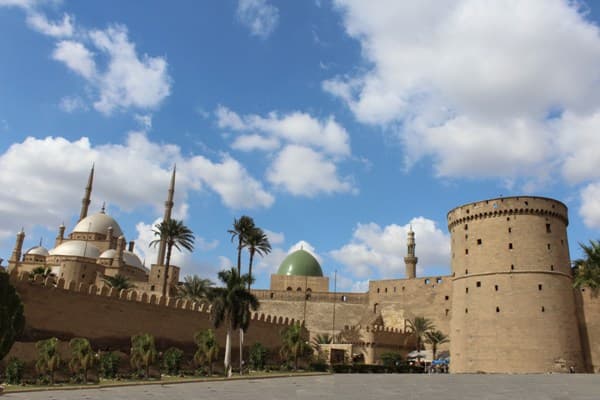
The History of Salah El-Din Citadel
The citadel was commissioned by the famous Muslim leader Salah El-Din (Saladin) in 1176 AD to protect Cairo and Fustat from Crusader attacks. Built on the highest point of the Mokattam Hills, the fortress provided a strategic defensive position and an excellent view over the city.
Although construction began during Saladin's reign, the fortress was completed by his successors and gradually expanded by the Ayyubids, Mamluks, and Ottomans. Over the centuries, it became the political heart of Egypt, serving as the official residence of the country's rulers until the nineteenth century.
A Fortress Filled with History
The citadel witnessed many of Egypt's most significant historical events. It housed royal palaces, government offices, military headquarters, and mosques, making it the center of political power for hundreds of years.
Today, visitors can explore several remarkable attractions inside the citadel, including:
The Mosque of Muhammad Ali
The Mosque of Al-Nasir Muhammad
The Mosque of Suleiman Pasha
Al-Gawhara Palace
The National Military Museum
The Police Museum
The Royal Carriages Museum
Each monument reflects a different chapter in Egypt's rich Islamic history.
The Magnificent Mosque of Muhammad Ali
The most recognizable landmark within the citadel is the Mosque of Muhammad Ali, also known as the Alabaster Mosque. Commissioned by Muhammad Ali Pasha, the founder of modern Egypt, construction began in 1830 and was completed in 1848, with finishing works continuing after his death.
The mosque was built in the Ottoman architectural style, inspired by the great imperial mosques of Istanbul. Its massive central dome, surrounded by smaller domes and crowned by two elegant minarets rising approximately 84 meters high, dominates Cairo's skyline and can be seen from many parts of the city.
Why Is It Called the Alabaster Mosque?
The mosque earned its famous nickname because both its interior and lower exterior walls are covered with beautiful alabaster stone, giving the building a warm golden glow. The richly decorated prayer hall features enormous chandeliers, intricate geometric designs, colorful stained-glass windows, and an impressive central dome that creates a sense of grandeur and serenity.
Inside the mosque lies the marble tomb of Muhammad Ali Pasha himself, making the monument both a place of worship and a historic mausoleum.
The Courtyard and the Famous Clock Tower
One of the mosque's most distinctive features is its spacious open courtyard. At its center stands an elegant ablution fountain, while a striking copper clock tower was presented to Muhammad Ali by King Louis Philippe of France in 1845. In return, Muhammad Ali gifted France one of the ancient obelisks from Luxor Temple, which now stands in Place de la Concorde in Paris.
Spectacular Views of Cairo
One of the highlights of visiting the citadel is its panoramic terrace overlooking Cairo. On a clear day, visitors can admire the city's historic skyline, the minarets of Islamic Cairo, modern neighborhoods, and even the Pyramids of Giza in the distance. The viewpoint is one of the best places in Cairo for photography.
Visiting the Citadel Today
The Salah El-Din Citadel remains one of Egypt's most popular tourist attractions. Whether you are interested in Islamic architecture, military history, photography, or simply enjoying breathtaking views, the citadel offers an unforgettable experience.
Its combination of imposing fortress walls, historic museums, royal palaces, and the magnificent Mosque of Muhammad Ali makes it one of Cairo's most rewarding cultural destinations.
A Symbol of Egypt's Enduring Heritage
More than eight centuries after its construction, the Salah El-Din Citadel continues to stand as a symbol of Egypt's strength, resilience, and architectural brilliance. Together with the magnificent Mosque of Muhammad Ali, it represents the rich legacy of Islamic Cairo and remains an essential stop for every visitor exploring the history and culture of Egypt.