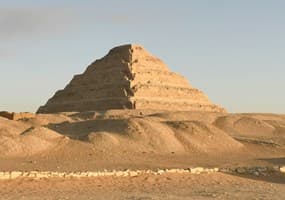
Home to the world's oldest large-scale stone building, the Step Pyramid of King Djoser, Saqqara marks the beginning of pyramid construction in ancient Egypt and remains one of the country's most fascinating destinations for history lovers.
The Step Pyramid of Djoser
The most iconic monument at Saqqara is the Step Pyramid of King Djoser, built during the Third Dynasty around 2670 BC. Designed by the brilliant architect Imhotep, the pyramid was the first monumental structure constructed entirely from cut stone.
Unlike the smooth-sided pyramids that would later be built at Giza, Djoser's pyramid consists of six stacked mastabas, creating its distinctive stepped appearance. This revolutionary design transformed royal tomb architecture and paved the way for the construction of Egypt's later pyramids.
Today, visitors can explore the pyramid complex, including its grand entrance colonnade, ceremonial courtyards, temples, and underground passages.
A Vast Ancient Necropolis
Saqqara is much more than a single pyramid. Stretching for several kilometers across the desert, it contains hundreds of tombs, pyramids, temples, and burial shafts dating from the Early Dynastic Period through the Greco-Roman era.
Among its remarkable monuments are:
The Pyramid of King Unas, famous for containing the earliest known Pyramid Texts.
The Pyramid of Teti, decorated with religious inscriptions designed to guide the king into the afterlife.
Beautifully decorated tombs belonging to high-ranking officials, priests, generals, and royal family members.
Ancient catacombs dedicated to sacred animals, including bulls, cats, ibises, and baboons.
These monuments provide an exceptional insight into daily life, religious beliefs, and artistic achievements throughout ancient Egyptian history.
The Serapeum
One of Saqqara's most intriguing attractions is the Serapeum, an underground complex that served as the burial place of the sacred Apis Bulls.
Massive granite sarcophagi, some weighing over 60 tons, line the underground galleries. The engineering required to transport and position these enormous stone coffins continues to amaze archaeologists and visitors alike.
The Apis Bull was considered a living manifestation of the god Ptah and later associated with Osiris, making the Serapeum one of the most sacred religious sites in ancient Egypt.
Ongoing Archaeological Discoveries
Saqqara continues to be one of the world's most active archaeological sites. Every year, Egyptian and international missions uncover new tombs, colorful coffins, statues, mummies, and artifacts that expand our understanding of ancient Egyptian civilization.
Recent discoveries include beautifully preserved burial shafts, gilded coffins, wooden statues, funerary masks, and workshops used for mummification. These remarkable finds demonstrate that Saqqara still holds countless secrets beneath its sands.
Why Visit Saqqara?
While the Pyramids of Giza attract millions of visitors each year, Saqqara offers a quieter and more immersive experience. Visitors can walk through ancient tombs adorned with vivid wall paintings, explore underground chambers, and stand before monuments that changed the course of architectural history.
Its proximity to Cairo makes it an ideal day trip, often combined with visits to Memphis and Dahshur.
Whether you are fascinated by archaeology, architecture, or ancient history, Saqqara provides an unforgettable journey into the origins of one of the world's greatest civilizations.
A Journey Through Time
Saqqara is more than an archaeological site—it is a living museum that tells the story of ancient Egypt's evolution over three millennia. From the revolutionary Step Pyramid of Djoser to richly decorated tombs and newly discovered treasures, every corner of Saqqara reveals another chapter in the remarkable history of the pharaohs.
For anyone visiting Egypt, Saqqara is an essential destination that offers a deeper understanding of the civilization that gave the world its first pyramids and continues to inspire generations of travelers and historians.