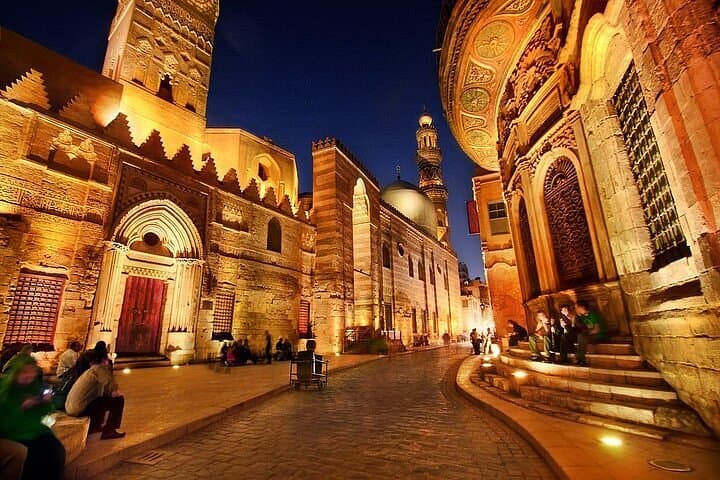
From majestic mosques and ancient madrasas to bustling bazaars and beautifully preserved streets, Islamic Cairo offers visitors an unforgettable journey through more than a thousand years of Egyptian history.
The Birth of Islamic Cairo :
The story of Islamic Cairo began in 969 AD, when the Fatimid Dynasty founded the city of Al-Qahira (Cairo) as the capital of their empire. Over the following centuries, successive dynasties—including the Ayyubids, Mamluks, and Ottomans—expanded and enriched the city with magnificent religious, educational, and commercial buildings.
As a result, Islamic Cairo became one of the most important centers of learning, trade, and culture in the medieval Islamic world, attracting scholars, merchants, and travelers from across Africa, Asia, and Europe.
A Living Museum of Islamic Architecture
Islamic Cairo is renowned for its extraordinary collection of historic monuments representing a wide variety of architectural styles.
Visitors can admire:
Magnificent mosques with elegant domes and towering minarets.
Historic madrasas (Islamic schools) that once educated scholars from around the world.
Ancient sabils (public fountains) and kuttabs (Quranic schools).
Beautifully decorated mausoleums and tombs.
Impressive city gates and medieval defensive walls.
Traditional houses featuring carved wooden mashrabiyas and peaceful courtyards.
Each monument reflects the artistic achievements of the Fatimid, Ayyubid, Mamluk, and Ottoman periods, making Islamic Cairo a treasure trove of architectural heritage.
Al-Muizz Street: The Heart of Historic Cairo
One of the highlights of Islamic Cairo is Al-Muizz li-Din Allah Street, often described as one of the world's greatest collections of medieval Islamic architecture.
Stretching for nearly one kilometer, this historic street is lined with beautifully preserved mosques, palaces, madrasas, caravanserais, and traditional houses. Walking along Al-Muizz Street is like stepping back in time, where every building tells a story of Cairo's glorious past.
The street becomes especially magical in the evening, when its monuments are beautifully illuminated and the surrounding cafés and shops come alive.
Adjacent to Al-Muizz Street lies the famous Khan El Khalili Bazaar, Cairo's historic marketplace that has been welcoming merchants and travelers for more than 600 years.
Its narrow alleys are filled with traditional shops selling handmade jewelry, brassware, lanterns, perfumes, spices, textiles, leather goods, and souvenirs. Visitors can also relax in historic cafés while enjoying authentic Egyptian hospitality.
Famous Landmarks
Islamic Cairo is home to many of Egypt's most celebrated monuments, including:
Al-Azhar Mosque, one of the oldest universities in the world.
Sultan Hassan Mosque and Madrasa, considered a masterpiece of Mamluk architecture.
Al-Rifa'i Mosque, the resting place of members of Egypt's royal family.
Bab Zuweila, one of the last remaining gates of medieval Cairo.
Beit El Sehemi, a beautifully preserved Ottoman mansion.
The Mosque of Ibn Tulun, one of the oldest and largest mosques in Africa.
The Citadel of Salah El-Din and the magnificent Mosque of Muhammad Ali.
Together, these landmarks represent more than a millennium of Islamic art, religion, education, and political history.
Culture and Everyday Life
Unlike many archaeological sites, Islamic Cairo is a living historic district where thousands of people continue to live and work. Traditional workshops still produce handmade copperware, wood carvings, textiles, jewelry, and other crafts using techniques passed down through generations.
Visitors can experience authentic Egyptian culture by exploring local markets, sampling traditional cuisine, listening to the call to prayer echoing through the narrow streets, and meeting the artisans who keep these ancient traditions alive.
Why Visit Islamic Cairo?
Islamic Cairo offers far more than historic monuments. It is a place where history blends seamlessly with everyday life, creating an atmosphere unlike anywhere else in the world.
Whether you are fascinated by architecture, photography, archaeology, religion, or local culture, the district provides endless opportunities for exploration and discovery.
Its narrow alleyways, magnificent mosques, bustling markets, and welcoming atmosphere make every visit a memorable experience.
A Timeless Legacy
For more than one thousand years, Islamic Cairo has stood as a symbol of Egypt's rich cultural and religious heritage. Its extraordinary collection of monuments, vibrant markets, and living traditions continue to inspire visitors from around the world.
From the grandeur of its medieval mosques to the charm of its ancient streets and bustling bazaars, Islamic Cairo remains one of Egypt's most captivating destinations—a place where the past lives on in every stone, every doorway, and every corner of this remarkable historic city.